NordVPN alternative? Local vs remote VPN
NordVPN is a remote VPN that masks your IP via its servers. GreenTunnel is a local VPN that doesn't. When each is the right tool.
People who search for a "NordVPN alternative" are usually after one of three things: a cheaper option, a different provider, or a tool for a narrower problem. GreenTunnel falls in the third group. It is not a competitor to NordVPN in the usual sense, and pretending it was would mislead you. This article explains the difference honestly, using what NordVPN says about itself and what GreenTunnel does, so you can choose.
What NordVPN is
NordVPN is a commercial, subscription-based remote VPN service. In NordVPN's own explanation, a VPN encrypts the traffic between your device and the VPN server, and the server forwards your requests to the internet with its own IP address in place of yours. The result is that:
- your ISP or the Wi-Fi operator sees a connection to a VPN server, not a list of the sites you visit, and
- websites see the IP address and rough location of the VPN server, not yours.
NordVPN states a no-logs policy, saying it does not store traffic data, visited websites or DNS queries, and it has commissioned independent assurance reviews. For example, Deloitte reviewed its infrastructure in late 2023, and the audit scope excluded some services. An audit is a snapshot in time, and you are still trusting a company with your traffic, which is the central trade-off of any remote VPN. Prices, server counts and feature sets change often, so check NordVPN's site for current details. We deliberately give no numbers here.
What GreenTunnel is
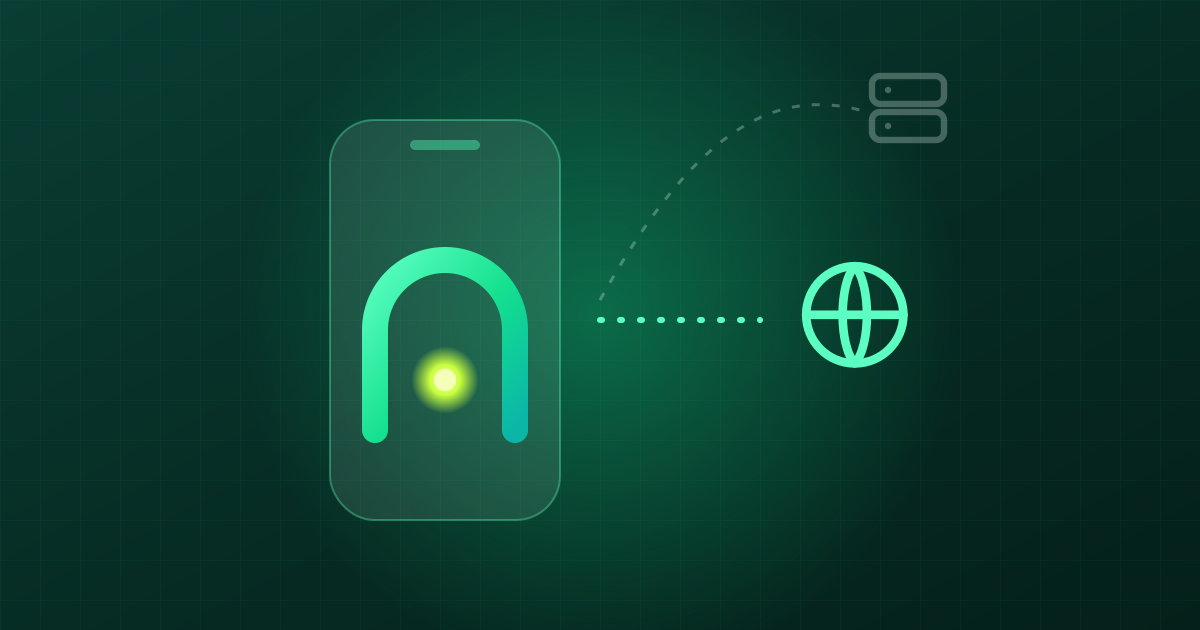
GreenTunnel is a local VPN. It uses the operating system's VPN interface only to receive traffic from your apps, then handles it entirely on the device:
- Encrypted DNS (DoH, DoT, DoQ), so the network cannot read or rewrite your DNS lookups. See encrypted DNS.
- Reshaping the first packets of a connection so a filter reading the site name does not recognise it. See what DPI is.
- Diagnostics and visibility: Inspect URL and Requester.
- Block lists and routing rules.
There is no relay server run by us, no account needed for the free features, and we never collect browsing content, domains or traffic. The honest flip side: because traffic still goes straight from your phone to the site, websites and your ISP still see your real IP address, and your ISP still sees which servers you connect to. GreenTunnel is not an anonymity tool.
Different problems, different tools
| You want to | Remote VPN (e.g. NordVPN) | GreenTunnel (local VPN) |
|---|---|---|
| Hide your IP address from websites | Yes, you show the server's IP | No |
| Appear in another country (geo-location) | Yes, subject to the service, and sites may still detect VPN servers | No. Only through a server you set up yourself (Premium) |
| Keep the Wi-Fi operator from seeing the sites you visit | Mostly. It sees only the VPN server | Partly. DNS is encrypted, but the connection's destination, and often the site name, remain visible |
| Fix a site broken by DNS tampering | Often, since DNS goes through the VPN | Yes, with encrypted DNS |
| Fix a site broken by name-based (SNI/DPI) filtering | Usually, since the filter sees only the tunnel. Some networks block VPNs themselves | Often, by reshaping the first packets |
| Fix a site blocked by IP address | Often, since you exit elsewhere | No, unless you route through your own server |
| Keep speed close to normal | Depends on the distance and load of the server | Traffic takes no detour, so usually close to normal |
| Trust model | You trust the VPN company | There is no company server to trust, but there is also no IP hiding |
| See which apps connect where | Not a core feature | Requester |
Streaming is a common reason to buy a remote VPN, but streaming services detect and block VPN servers on their own schedule, and their terms may forbid circumvention. No VPN can promise access to a catalogue. We do not promise it either, and we do not offer a way to change your country.
When GreenTunnel is enough
- A site fails on your ISP or Wi-Fi but works on another network, and the cause is DNS or name-based filtering. Inspect URL tells you which.
- You want encrypted DNS and ad or scam blocking without a detour in your traffic.
- You want to see which apps send data where.
- You are fine with websites seeing your real IP, as they do today.
When you need a remote VPN
- You want websites not to see your real IP address.
- You need to appear in another country, where that is allowed by the service and by law.
- You are on a network you do not trust and want the operator to see only a tunnel. Read public Wi-Fi safety first, since HTTPS already protects most content.
- The block is by IP address or the network blocks the protocol that local tools rely on.
If you already have a server you trust, such as a VPS, GreenTunnel can route selected traffic through it instead: see Proxy Route, Tunnel Link and running your own WireGuard server. This is Premium, and you are then the one running the server.
Can you use them together?
Not at the same moment. Android and iOS allow one active VPN at a time. You can switch between them, for example GreenTunnel day to day and a remote VPN when you need to hide your IP. Some remote VPN apps offer their own features for filtered networks. Check their documentation rather than assuming.
GreenTunnel is free on Android and iPhone, with optional Premium. See the home page, or read Do I need a VPN? to decide what you actually need.
FAQ
Is GreenTunnel a free replacement for NordVPN?
No. They do different jobs. GreenTunnel is free to use but does not hide your IP address or change your location. If you need those, a remote VPN is the right category.
Does GreenTunnel encrypt all my traffic like a remote VPN?
No. It encrypts DNS and reshapes the start of connections. Traffic stays as protected as it already is: HTTPS content is encrypted by the site, and plain HTTP stays plain.
Which is safer on public Wi-Fi?
HTTPS already protects most content on any Wi-Fi. A remote VPN adds a tunnel that hides your destinations from the Wi-Fi operator. GreenTunnel adds encrypted DNS. See public Wi-Fi safety for the details.
Do I have to trust GreenTunnel with my traffic?
Your traffic does not pass through any server of ours. It is processed on your device and sent straight to the destination, or to a proxy or tunnel that you chose.
Sources
- NordVPN, How does a VPN work? (how a VPN encrypts traffic and masks the IP address), as summarised in October 2026.
- CyberInsider, Independent Deloitte audit verifies NordVPN's no-logs claim (January 2024: audit dates, scope and exclusions, as reported by the press).
NordVPN is a trademark of its owner and is mentioned here only to identify the product. We are not affiliated with it. We did not verify current pricing, server counts or streaming support, so none is stated. Check NordVPN's site for current details.